
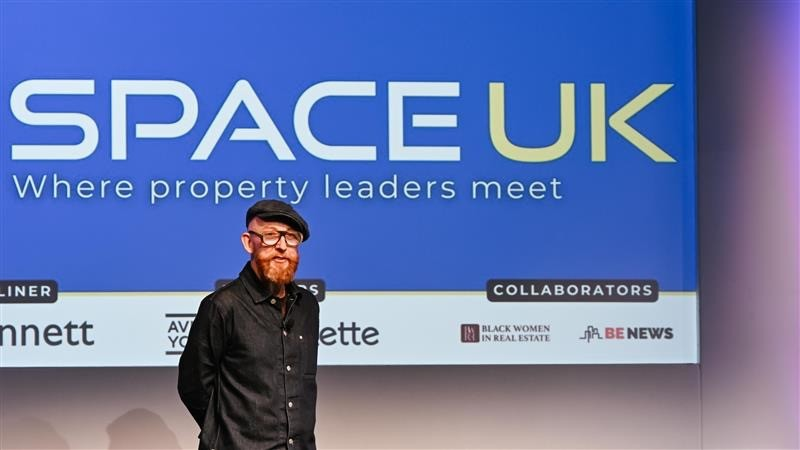
The urban strategist behind FreeState is rebuilding his practice around a method, not a personality, with a new venture called the Experience Foundation.
Adam Scott has spent nearly three decades studying why some places pull people in and others push them away. He calls himself an urban strategist, though his work stretches across university campuses, airports, workplaces and entire city districts, wherever an operator has to think seriously about how thousands or millions of people move through, feel about, and return to a place. His client list includes Nike's 236 acre campus in Portland, Oregon, RMIT in Melbourne, and a three year engagement with the University of Leeds, and he recently delivered a keynote on the future of cities at the Dubai Future Forum.

That track record was built through FreeState, the agency Scott co-founded 25 years ago with his then girlfriend, later wife, Charlotte, and a business partner named Ben Johnson, after meeting as students at the Royal College of Art in the late 1990s. Their first project, an energy neutral installation built around a wind turbine on London's South Bank, did not go especially well. The founders realized what they had promised and rendered was radically different from what they could actually deliver on the ground, and that passion alone was not enough without a full ecosystem of specialists around them. FreeState went on to work with the V&A, the Science Museum, Sony and Samsung, before being acquired by the Hassell Group roughly a decade ago.
Earlier this year, Scott stepped away from FreeState entirely to launch a new venture, the Experience Foundation, with two other co-founders, workplace strategist Sue Lim in Melbourne and architect Charlotte Boyens. He describes it as a deliberate widening of scope: FreeState had increasingly been pigeonholed as an architecture practice, when the actual work touched brand, technology, culture and design all at once. The bigger shift, though, was personal. Scott has come to see it as a shortcoming that FreeState's identity stayed so tightly bound to his own, something he tried and largely failed to separate over 25 years. Letting the brand go, he admits, was frightening precisely because of how much of himself was invested in it. Experience Foundation is positioned to be more neutral and systemic from the outset, and rather than chasing new projects to deliver, the business is oriented toward training client teams and embedding its methodology directly inside their organizations.
Underpinning that methodology is what Scott calls the engagement crisis in cities: as more of daily life, learning, work, shopping, socializing, moves onto screens, the physical reasons to gather in real life keep shrinking, even though people are healthier and happier when they do. His teams pair qualitative research, surveys, interviews, workshops, with large scale quantitative movement data to build a picture of how people actually behave in a space, then use that to brief everything from architecture to technology to brand.
Scott is currently developing what he describes as a pattern language for city design, distilling 25 years of project work into reusable principles, with early applications planned across the UAE