
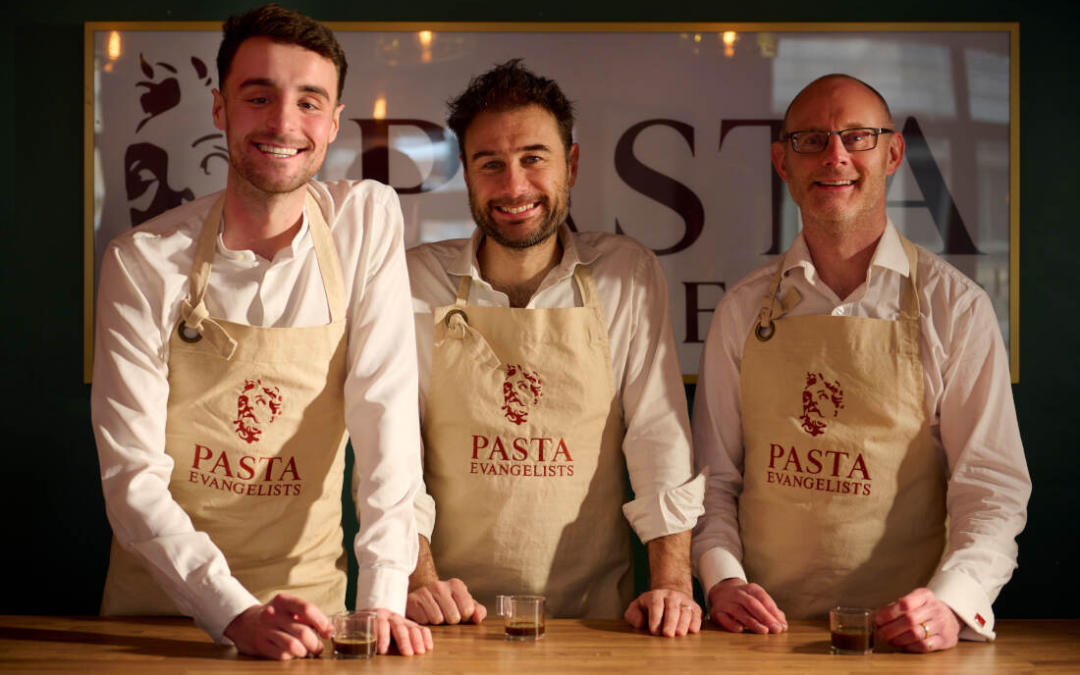
Chris Rennoldson helped grow Pasta Evangelists from a two-man delivery run into a 50-restaurant business acquired by Barilla, but he now faces the challenge of stepping into public view after years of staying behind the scenes.
Chris Rennoldson spent twelve years in corporate development in the City, much of it around the London Stock Exchange, before deciding to leave finance altogether. Rather than move into another strategy role at a bank, he took time out and enrolled full-time at Leith's Cookery School, a London culinary school often compared to Cordon Bleu, treating the nine-month course less as a career change and more as a personal MBA. The experience convinced him he had no interest in becoming a working chef in his forties with a young family to support. What it did clarify was a different ambition: combining his commercial background with his interest in food.
After a stretch developing his own ideas without traction, and a period contracting for a business catering service, Rennoldson was introduced to Alessandro, who had an idea for a pasta delivery business. The two hit it off, and within days they were preparing pasta meals together out of a site in Leytonstone. Eight and a half years later, that partnership has grown into Pasta Evangelists, a business with 50 restaurants and takeaway kitchens, roughly 400 employees, and a run rate Rennoldson has put at around £36 million. The company was sold to Barilla, which Rennoldson describes as the world's biggest pasta company, four years ago, a deal that removed the pressure of ongoing investor funding rounds from how the business is run.
By Rennoldson's own account, around 5% of the UK population eats Pasta Evangelists, but the company has not achieved the brand recognition of more established casual dining names such as Wagamama or Nando's. That gap has become a live business question rather than a private frustration. Rennoldson has said his personal profile is a weak point, recalling that his company's CMO recently told him his LinkedIn page looked out of date and needed a complete overhaul. For a business that cannot match larger rivals on advertising spend, he sees founder visibility and storytelling as one of the more realistic ways to close that awareness gap, alongside the physical footprint of opening more restaurants.
It is also, by his own admission, not a natural fit. Rennoldson describes himself as internally focused, drawn to operations and data rather than external relationship-building, and he has said business development is not where he naturally spends his time. That tension, between a founder instinct to solve problems from first principles on his own and a business need to be more visible and more networked, is one he has been actively thinking through rather than one that has been resolved.
What clearly still animates him is the product itself. He has described Thursdays, the day he spends at the company's food development site tasting new concepts with the executive chef, as his favourite of the week, and talks about the shift to physical restaurants as the stage where he finally gets to watch customers enjoy the food directly.
Rennoldson remains focused on the operational side of the business, the data, the growth levers, the day-to-day of running 50 sites, even as the question of how much of his own story to put forward stays open.