
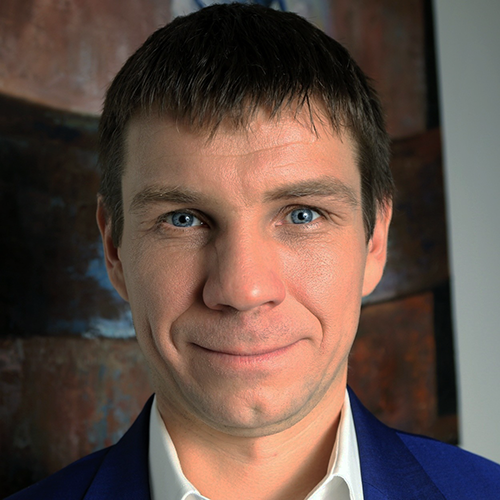
The Fusion partner built JustFA to bring together the dozen or so tools a typical advice firm juggles, and is now working on getting the industry to change how it operates.
Since the pandemic, video meetings have become routine for many UK financial advisers. What sits behind those meetings is another matter. Taras Rybak, a partner at investment and wealth management group Fusion, believes the next shift in advice is less about where advisers meet clients and more about how many systems they need to serve them.
Rybak left Ukraine around 20 years ago, straight after university. A hospitality job secured him a visa, but he soon left for London, where his first business role was commission-only direct sales of insurance and healthcare products from shopping centre stands. He moved into executive search, placing senior people in investment banks and funds across emerging markets, until the 2008 financial crisis halted hiring and he was made redundant. In 2011 he co-founded Investcap Group, which sourced large construction and infrastructure projects for Chinese state funding. Rybak originated a project in Crimea worth more than one billion, spanning an airport, a seaport, housing and agriculture. Four to five years of work ended when war broke out and Crimea came under Russian control, and the partners closed the business.
He joined Fusion on a single project, then full time, later becoming a partner and shareholder. Fusion started in 2004 as a quantitative hedge fund for institutional investors. In 2016 or 2017 it began looking at the UK retail market, saw an opportunity for consolidation and set about acquiring independent financial advisory firms. Today the group, which manages more than £2 billion and employs around 140 people, runs three lines of business: a financial planning and advice arm with more than 30 advisers and over 6,000 clients, which holds around 80 percent of assets; an investment management business running portfolios that advisers allocate client money to; and JustFA, a platform combining an adviser's technology stack with custody of client assets and investment options.
The thinking behind JustFA took shape as robo-advice drew attention and some predicted advisers would disappear within a couple of years. Rybak disagreed. "The future is really hybrid," he says, likening technology to an exoskeleton: the human still brings the judgement and empathy, but can carry far more. Fusion first built the platform for its own advisers, then concluded that most UK advisory firms, 80 to 90 percent of which are small and medium-sized businesses, shared the same challenge, and opened it to the wider market. Built largely in-house because nothing suitable existed, it was expected to take about a year and around a million. It took roughly five times as long and cost five to six times as much, launching around a year and a half before this interview.
The problem it targets is fragmentation. Rybak cites figures suggesting the average advice firm uses around 12 separate tools, from CRM to risk profiling to suitability reports, and says keeping them working together gets harder as a firm grows. Across a number of advice firms, Fusion found that 30 to 40 percent of clients generated about 10 percent of revenue yet took up 30 to 40 percent of adviser resources. Serving those clients digitally, still through a qualified, regulated human adviser, frees up 20 to 30 percent of resources, an effect Fusion quantified in a case study with one firm. Rybak connects this to the advice gap: roughly five to six million people in the UK pay for advice, and around another six million would if it were more affordable.
The harder part is adoption. Before the pandemic, advisers largely told Fusion they preferred meeting clients face to face; lockdown softened that. Now, Rybak says, firms accept the argument but push the decision back until after a holiday, the end of tax season or the new year. Larger firms planning five or ten years ahead, including those that may one day sell, are the ones he sees recognising technology's growing importance. He frames the change less as adding a tool than as changing how the work gets done, comparing it to the move from calculators to Excel, and says it takes a degree of change management and internal champions willing to lead it.
Rybak, who boxed professionally for six or seven years and still spars most Saturdays, compares business to the ring: a fighter who is technically stronger can still be put down by a punch he was not watching for.
For the next three to five years, his focus is scaling: continuing acquisitions, improving the businesses Fusion owns and taking JustFA to more advisers. The core product is ready, he says, with AI capability and further investment options still being added. How quickly the rest of the market follows is the question those years will answer.